
Malaysia is one of the leading trading economies in Southeast Asia, mainly because of its strategic geographical location, developed manufacturing capabilities, strong logistics infrastructure, and extensive connections. The country plays an important role in global commerce, mainly because of its exports of electronic products, petroleum products, palm oil, plastics, and medical equipment. The Malaysian authorities have maintained the country’s role as an important destination for international suppliers. Malaysia Import Data provide valuable trade intelligence to companies looking for expansion of their international business operations.
The detailed trade information helps businesses get proper identification of active importers, evaluation of suppliers, analysis of product demand, and understanding of the sourcing patterns. Malaysia Trade Data provides a category-wise detailed visibility into the top resource essentials and the traded product categories along with the shipment activity, trading partners, and the changing commercial trends. Businesses can use the shipment-level intelligence for the development of targeted sales, improvement of the sourcing decisions, and identification of emerging market opportunities.
THE SIGNIFICANT ROLE OF MALAYSIA IN GLOBAL TRADE
Malaysia has maintained its role as one of the top regional traders in international trade because of its strategic location along major Asian trade routes. The developed infrastructure and the strong participation of the country in the regional supply chain have supported the overall trade growth. The recognition of the nation for electrical and electronic products trade, petroleum products trade, and rubber products trade has supported the overall economic growth rate. The geographical positioning of Malaysia provides strong connectivity with major commercial economies. Japan, Thailand, Indonesia, South Korea, Vietnam, and other Asian markets are the bilateral traders driving the economic growth rate.
Different ports and logistics support the movement of raw materials, intermediate goods, and finished products. Malaysia Shipments Data provides detailed visibility into the movement of products. The companies can get a proper analysis of the shipment activity, product categories, and supplier countries for an understanding of the competitive structure of the Malaysian market. The manufacturers, wholesalers, and international exporters can use the intelligence for the development of market entry and expansion strategies.
THE COMPREHENSIVE OVERVIEW OF MALAYSIA IMPORTS
Malaysia has been a diversified import market trader, mainly because of the strong manufacturing, industrial production, energy requirements, infrastructure development, and consumer demand rate. Traders can get the latest evaluation of iron and steel products, transport equipment, food products, and industrial raw materials. Businesses trying to be progressive can stay updated with the electrical and electronic products contribution to the import activity, along with integration into the global semiconductor and electronics supply chain.
Malaysia’s import of electronic component integrated circuits and semiconductor-related products has supported domestic manufacturing and re-export activities. Energy products mainly contribute to the import requirements. Crude petroleum, refined petroleum products, and energy-related commodities support industrial operations. Malaysia import data allows businesses to study purchasing patterns and maintain associations with energy products and identify companies involved in the procurement and industrial consumption rate.
The machinery and industrial equipment trade of the nation provides important areas of opportunity to beginner traders. Manufacturers looking for service expansion can refer to production machinery, electrical equipment, automation systems, and precision instruments for expansion of the production capacity with improvement of the operational efficiency. The international suppliers can use the Malaysia Customs Data for clarified identification of active buyers and evaluation of the demand rate for specific machinery. Malaysia mainly imports chemicals, plastics, pharmaceuticals, and food products for industries looking for Malaysia Trade Statistics to understand the demand patterns.
THE EXPORT MARKET OVERVIEW OF MALAYSIA
Malaysia is an important export-oriented economy, mainly backed up by strong manufacturing capabilities, natural resources, agricultural production, and the integrity of the international supply chain. Malaysia Export Data provides detailed insights into the products with effective supply rates to international markets and purchasing histories. Electrical and electronic products traded from the nation mainly contribute to the export growth rate.
The establishment of semiconductor, electronics, and component manufacturing has promoted bilateral integrity with Asian, North American, European, and other global markets. Malaysia export trade data helps businesses understand the destination markets and potential buyer relationships. Petroleum and petroleum-related products contribute significantly to Malaysian exports. The country, with the establishment of an energy industry, can maintain trade connections through involvement in crude oil, refined petroleum, LNG, and other energy commodities.
Palm oil and other agricultural products represent another important sector. Malaysia is one of the active participants in the global palm oil industry, with related products traded to international markets. The export opportunities mainly include rubber products, chemicals, plastics, machinery, and precision instruments trade. The strategic position within the Asian supply chain has further supported the exports of intermediate and finished manufactured products. The companies are mainly using the Malaysia shipment data for identification of high-demand destination markets and evaluation of the opportunities.
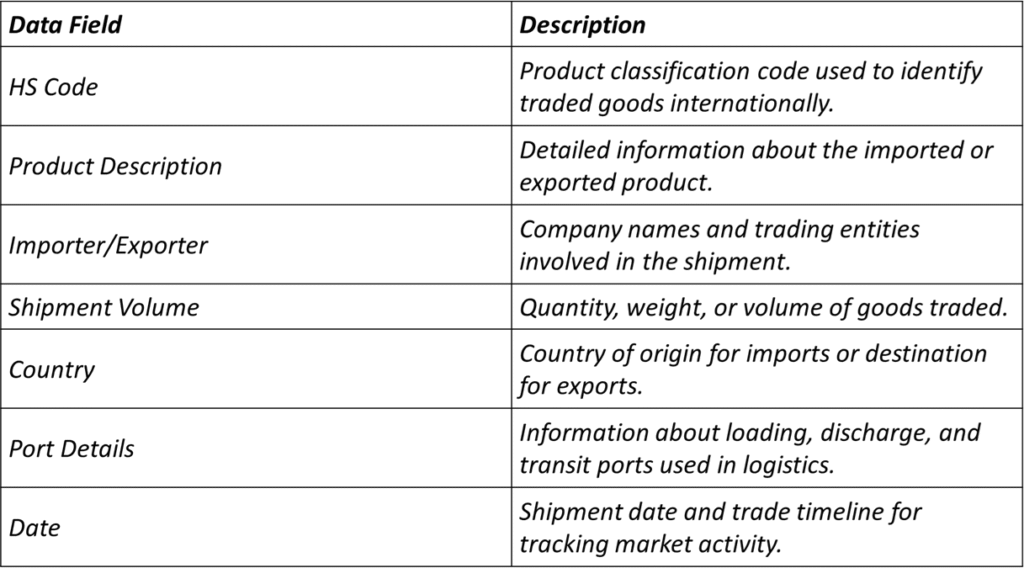
WHAT DETAILS ARE INCLUDED IN MALAYSIA CUSTOMS DATA?
THE EFFECTIVENESS OF MALAYSIA IMPORT DATA AND MALAYSIA CUSTOMS DATA IN BUSINESS GROWTH
Malaysia import data and Malaysia customs data are considered valuable trade intelligence for market expansion. The historical trade information enables businesses to identify active importers, examine purchasing activity, and understand sourcing strategies. Businesses can analyse the latest trade patterns along with supplier countries and purchasing patterns for the development of the targeted buyer list. The exporters can identify the companies for regular purchase of specific products along with prioritization of the prospects as per the shipment activities.
The competitor analysis is an important application supporting Malaysia shipment data. The companies can use the monitoring of shipment activity for understanding of the competitor sourcing, supplier relationships, and market participation. The information can support competitive positioning with identification of areas where they can differentiate their products or services. Malaysia customs data overall supports supply chain optimization while helping the companies examine the supplier countries with alternative sourcing markets, trade routes, and product movements. The businesses can use the latest insights for diversification of the supply base with a reduction in the dependency on individual suppliers or markets.
HOW DOES MALAYSIA IMPORT-EXPORT DATA SUPPORT BUSINESS GROWTH?
- Identification of verified buyers and suppliers – Malaysia import-export data helps businesses get proper trade clarification with active participation in international trade. The traders can get the latest evaluation of trade values while supporting the development of targeted buyers and supplier’s databases.
- Competitors’ shipment monitoring – Businesses can use the monitoring of shipment activity to understand the product categories. The latest intelligence helps the companies improve the competitive positioning along with development of the sales and strategies.
- Market demand analysis – The historical Malaysia trade data allows businesses to study the product demand and shipment frequencies. The declining activity overall encourages businesses to reassess their market strategy.
- Supply chain optimization – Malaysia customs data properly clarifies procurement decisions by providing visibility into supply markets, trade routes, and product movements. The companies can use the insights for identification of alternative suppliers and improvement of supply chain resilience.
- Identification of emerging opportunities – Malaysia shipment data reveals the changing buyer activity along with emerging supply markets and new product opportunities. Progressive businesses use the signals for identification of potential opportunities.
THE FUTURE TRADE OUTLOOK OF MALAYSIA IMPORT-EXPORT DATA
The international trade outlook of Malaysia is mainly connected with technological development. Electrical and electronic products, chemicals, palm oil, plastics, and other manufactured products are mainly contributing important roles in international commerce. The increasing importance of semiconductor and electronics supply is maintaining the creation of opportunities for manufacturers, component suppliers, machinery, and technology companies. The supply chain diversification now across Asia is creating additional opportunities for Malaysian businesses.
The strong connections with Asian markets and major global economies are supporting international commercial relationships. Businesses can use the Malaysia Export Data and Malaysia trade data for the development of major destination markets, along with sourcing diversification and buyer identification. The global supply chain can evolve with detailed trade intelligence, which has made the data set increasingly important for businesses looking for informed procurement strategies.
Conclusion
Malaysia is an important trading economy in the global marketplace mainly because of its advanced manufacturing capabilities, technological development, and developed logistics infrastructure. The country is popular for the import market that creates opportunities across electrical and electronic products. The Malaysia export data strongly represents the solidification in electrical and electronic products, petroleum products, and palm oils. Malaysia customs data and Malaysia shipment data provide valuable intelligence to business authorities for evaluation of sourcing markets and identification of active buyers. The companies can effectively utilize the Malaysia trade data for development of the targeted business strategies and strengthening of the relationships with the leading traders.
CTA
If you are trying to expand your business on a global scale, mainly in Malaysia, you have landed at the right platform here. Import Globals holds expertise in providing detailed information regarding the suppliers, importers, and exporters along with the shipment activities from a specific region. The platform overall supports businesses with evaluation of suppliers, analysis of market demand, and monitoring of competitors. Subscribe to www.importglobals.com and drop an email at info@importglobals.com for detailed analysis of the Malaysia trade to upgrade your global business growth rate.
FAQs
Que –What are the top imported products of Malaysia in 2025?
Ans –Electrical and electronic equipment along with machinery are the top variants imported in Malaysia in 2025.
Que –What are the top exported products of Malaysia in 2025?
Ans –Electrical and electronic products, along with palm oil and machinery, are the top exported products of Malaysia in 2025.
Que –How does Malaysia import-export data support business growth?
Ans -Malaysia import-export data supports business growth via proper identification of buyers, supplier analysis of market demand, and development of effective market expansion strategies.
Que –What information is available in Malaysia trade data?
Ans -Malaysia trade data covers Importer names, Exporter names, Shipment date, HS Code, Product Details, quantity, values, pricing information, origin country, importing country & port details.
Que –How frequently is Malaysia trade data updated?
Ans -Malaysia trade data is updated on a monthly basis.
Que –Where can you obtain detailed information on Malaysia trade data?
Ans –Visit www.importglobals.com and drop an email at info@importglobals.com for detailed information on Malaysia trade data.
